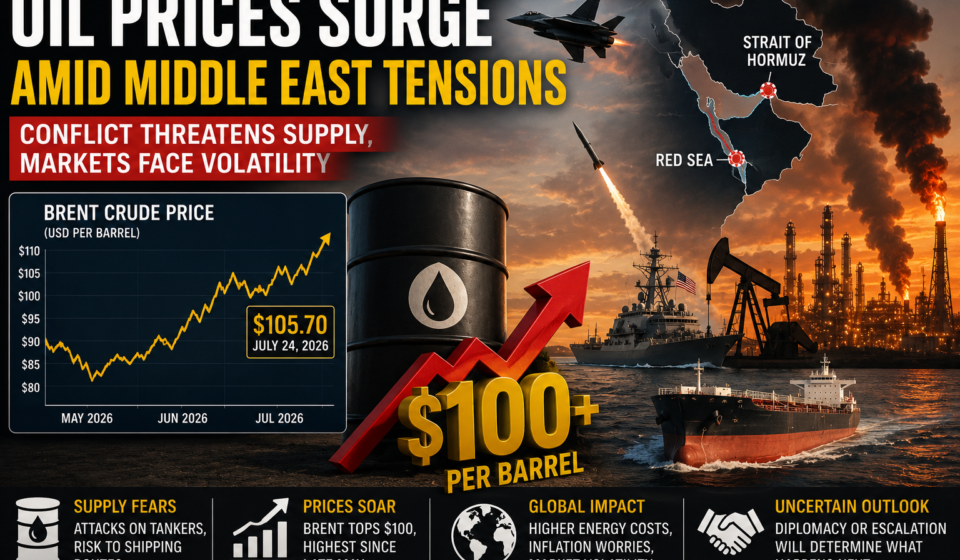

1. Crude Prices Climb as Conflict Threatens Global Supply
Global oil prices have risen sharply as fighting in the Middle East threatens some of the world’s most important energy-producing regions and shipping routes.
Brent crude, the international oil benchmark, moved above $100 per barrel during the latest surge. Physical crude grades climbed even higher, with some approaching $110 per barrel as buyers competed for supplies that could be delivered without passing through dangerous maritime zones.
Brent reached approximately $105.70 per barrel at one stage, its highest level since late May. North Sea Forties crude was quoted near $108.77, while prices for several Middle Eastern grades also rose significantly.
The increase followed renewed military exchanges involving the United States and Iran, along with attacks by Yemen’s Iran-aligned Houthi movement on vessels in the Red Sea.
Two Saudi oil tankers were reportedly attacked, intensifying fears that the conflict could interrupt shipments from the Gulf to customers in Europe and Asia.
Oil futures later pulled back from their highest levels. Brent dropped below $100 after briefly moving above $102, illustrating how rapidly the market is reacting to every military and diplomatic development.
Despite the retreat, prices remained substantially higher for the week. Brent gained close to 10%, while U.S. West Texas Intermediate crude rose by more than 8%, according to weekly market data.
The volatility reflects uncertainty rather than a complete loss of global oil supply.
Traders are pricing in the possibility that transportation routes could be disrupted, production facilities could be damaged or countries could struggle to deliver crude to international buyers.
Even when oil continues to flow, the risk of an interruption can raise prices.
Shipping companies may charge more to enter dangerous waters. Insurance premiums can increase. Tankers may be forced to take longer routes, while refiners may pay additional amounts to secure alternative supplies.
These expenses become part of the market price of oil.
The latest surge also shows how quickly energy markets can change. Brent was trading near $84 per barrel on July 16, but moved above $100 roughly a week later as the conflict intensified and shipping concerns grew.
Oil prices have been unusually unstable throughout 2026.
Earlier in the year, Brent briefly climbed above $126 per barrel as concerns about the U.S.–Iran war intensified. Prices later declined when shipping conditions improved and diplomatic hopes increased.
The newest rally demonstrates that the market remains extremely sensitive to developments in Iran, Yemen and nearby waterways.
2. Strait of Hormuz and Red Sea Become Central Concerns
Two strategic shipping corridors are at the center of the oil-market crisis: the Strait of Hormuz and the Red Sea route through the Bab el-Mandeb Strait.
The Strait of Hormuz connects the Persian Gulf with the Arabian Sea. Oil and gas exports from Saudi Arabia, Iraq, Kuwait, Qatar, the United Arab Emirates and Iran normally pass through or near the narrow waterway.
Because a large share of global petroleum supply depends on this route, even limited interference can influence prices around the world.
The conflict between the United States and Iran has repeatedly raised concerns that traffic through the strait could be restricted.
Iran has attacked commercial vessels during the conflict, while U.S. military operations have targeted Iranian naval and missile capabilities. Oil prices rose after attacks on ships and new American strikes against Iran.
Some tankers have delayed voyages or waited for security conditions to improve.
Others have faced higher insurance charges because shipping companies and insurers consider the region more dangerous.
The Red Sea presents a separate but connected threat.
The Houthi movement has attacked commercial vessels and threatened shipping connected to Saudi Arabia. Its activity affects the route leading through the Bab el-Mandeb Strait and toward the Suez Canal.
The Suez route is one of the fastest ways to transport goods and energy between Asia and Europe.
When ships avoid the Red Sea, they often travel around the southern tip of Africa. That journey can add thousands of miles, increase fuel consumption and delay deliveries.
Saudi Aramco has reportedly offered alternative crude shipments through Egypt’s Sidi Kerir terminal because of concerns surrounding Red Sea transportation. Asian refiners have also searched for different suppliers and routes.
The effects are not limited to oil from the Middle East.
Supply difficulties involving Kazakhstan have added to market pressure. Production was reduced after suspected Ukrainian drone strikes disrupted operations connected to the country’s main export terminal.
Kazakh supply problems increased demand for crude from the North Sea and West Africa.
When buyers cannot obtain their usual shipments, they turn to other regions. That can raise the price of alternative grades even when those supplies are far from the conflict.
Middle Eastern crude premiums also increased.
Prices for Dubai, Oman and Abu Dhabi’s Murban crude rose as Asian buyers attempted to secure reliable cargoes. Some premiums more than doubled, reflecting competition for barrels that could be delivered with fewer security risks.
This demonstrates how disruption in one region can spread through the entire market.
A refinery in Asia may replace Gulf oil with African crude. A European buyer may then compete for the same African supply. The resulting competition can raise prices across several markets at once.
Analysts have warned that a serious Houthi blockade or prolonged interruption could push Brent toward $115 or $120 per barrel.
Such forecasts are not guarantees. Prices could fall quickly if shipping resumes safely or if a ceasefire is reached.
However, the possibility of further escalation is encouraging refiners and traders to pay more for immediate and secure deliveries.
3. Higher Oil Prices Increase Inflation and Economic Pressure
The oil-price surge is affecting more than energy companies and commodity traders.
Crude oil influences the cost of transportation, manufacturing, agriculture, aviation and consumer products. When oil becomes more expensive, those costs can spread through the global economy.
Gasoline and diesel prices may rise as refiners pay more for crude.
The increase is not always immediate because retail fuel prices also depend on taxes, refining capacity, inventories and local competition. Nevertheless, sustained increases in crude prices usually place upward pressure on fuel costs.
Diesel is especially important because trucks, ships, trains and heavy machinery depend on it.
Higher diesel prices can make it more expensive to transport food, clothing, electronics and construction materials.
Airlines may face higher jet-fuel expenses.
Some carriers protect themselves through fuel-hedging contracts, but they may eventually raise ticket prices, reduce routes or introduce additional fees if energy costs remain elevated.
Agriculture is also vulnerable.
Farmers use fuel to operate tractors, irrigation systems and harvesting equipment. Fertilizer manufacturing can depend heavily on natural gas and other energy inputs.
Higher production and transportation expenses may eventually contribute to higher food prices.
The latest oil rally has also affected financial markets.
Bond yields rose as investors worried that higher energy costs could keep inflation elevated. Market expectations shifted away from interest-rate cuts and toward the possibility that central banks might need to maintain or even increase borrowing costs.
Long-term U.S. Treasury yields climbed sharply during the market reaction. Stocks in several Asian markets also fell as investors considered the possibility of slower economic growth combined with renewed inflation.
This combination is particularly difficult for policymakers.
If central banks reduce interest rates to support growth, they may risk allowing inflation to rise further. If they keep rates high to control inflation, businesses and consumers face more expensive borrowing.
The Federal Reserve’s next policy decision has therefore gained additional importance.
Before the newest energy shock, investors were focused on economic growth and the possibility of future rate reductions. Oil above $100 introduces another inflation risk that policymakers must consider.
Countries that import most of their energy may suffer more than major oil producers.
Importing nations must spend additional money to purchase the same amount of fuel. Their trade deficits may widen, their currencies may weaken and governments may face pressure to subsidize gasoline or electricity.
Energy-exporting countries can benefit from higher prices through increased revenue.
However, even producers face risks. Attacks on infrastructure, shipping interruptions and a broader regional war could threaten their facilities and long-term investment.
High oil prices may also weaken global demand.
Consumers who spend more on gasoline and electricity have less money available for restaurants, travel, clothing and other purchases.
Businesses may postpone expansion when transportation and manufacturing costs become unpredictable.
Therefore, an oil-price surge can initially benefit energy companies while creating challenges for the wider economy.
4. Why Prices Have Not Risen Even Further
The conflict is serious, but the oil market has not experienced a complete supply collapse.
Several factors have prevented prices from moving permanently toward the extreme levels predicted earlier in the war.
The first is that producers and traders have found alternative routes.
Tankers can avoid dangerous waters, although doing so increases costs and travel time. Saudi Arabia and other exporters also have access to pipelines and terminals that reduce dependence on a single shipping corridor.
The second factor is global oil inventories.
Governments and private companies hold stored crude and refined fuels that can temporarily replace delayed shipments.
Major consuming countries also maintain strategic petroleum reserves that could be released during a severe supply emergency.
The third factor is production outside the Middle East.
The United States, Canada, Brazil, Guyana, Norway and several African countries provide significant quantities of oil to global markets.
When Middle Eastern supply becomes uncertain, buyers can seek more crude from these regions.
The fourth factor is weaker demand in some major economies.
Reduced Chinese crude imports have helped limit the market’s response, according to energy-market reporting.
If economic growth slows, demand for fuel may decline, placing downward pressure on oil prices.
The market has also responded strongly to diplomatic news.
In March, oil prices fell by roughly 11% after the United States postponed planned strikes and reported constructive discussions with Iran. Brent settled near $99.94 following the decline.
In June, Brent dropped to approximately $73.74 when traders expected smoother tanker traffic through the Strait of Hormuz.
These rapid declines show that a significant part of the oil price reflects a geopolitical risk premium.
The risk premium represents the additional amount buyers are willing to pay because future supplies appear uncertain.
When the threat of disruption increases, the premium grows. When negotiations advance or ships begin moving safely, it can disappear quickly.
This explains why oil can rise or fall several dollars during a single trading session even when actual production has changed very little.
The market is not only reacting to current supply. It is continuously estimating what supply might look like tomorrow, next week or next month.
For that reason, traders are monitoring military statements, tanker movements, negotiations and attacks almost as closely as traditional production and inventory data.
5. What Could Happen Next in the Global Oil Market
The future direction of oil prices will depend primarily on the conflict and the security of major shipping routes.
A ceasefire or successful diplomatic initiative could lead to a rapid price decline.
If the United States and Iran reduce attacks and the Houthis stop targeting vessels, shipping companies may return to normal routes. Insurance costs could fall, delayed cargoes could move and buyers might become less willing to pay high premiums.
Prices could also decline if major producers increase output.
OPEC and its partners may consider whether additional supply is needed to stabilize the market, although individual members may have different priorities.
The United States and other governments could release oil from emergency reserves if fuel prices become economically or politically damaging.
A more dangerous outcome would involve the prolonged closure of the Strait of Hormuz or a successful blockade of the Red Sea route.
That could remove or delay millions of barrels of daily supply and force a much larger restructuring of global trade.
Under such conditions, analysts’ forecasts of $115 to $120 oil would become more plausible. Prices could move even higher if production facilities were directly damaged.
Another risk is simultaneous disruption in multiple regions.
The market is already dealing with Middle Eastern conflict and reduced Kazakh exports linked to the war in Ukraine. Additional sanctions, infrastructure attacks or weather-related disruptions could place further pressure on supplies.
However, demand destruction could eventually stop the increase.
If oil becomes too expensive, consumers drive less, airlines reduce flights and companies search for alternatives. Economic growth may slow, reducing overall energy consumption.
This creates a natural limit, although the adjustment can be painful.
For consumers, the immediate impact will depend on how long the increase lasts.
A brief price spike may have only a limited effect on gasoline and other goods. A prolonged period above $100 per barrel would create much broader inflationary pressure.
For governments, the challenge is balancing energy security, inflation and foreign policy.
They must protect shipping, support economic stability and avoid actions that could trigger an even larger war.
For oil companies, the high-price environment can increase revenue, but it also creates operational and investment uncertainty.
Projects in conflict-prone regions may be delayed, while shipping and security expenses rise.
The present surge is therefore not simply a story about higher commodity prices.
It reflects growing concern that military conflict could interrupt the energy flows on which the global economy depends.
As long as fighting continues near the Strait of Hormuz and the Red Sea, oil markets are likely to remain volatile.
Prices may move sharply in either direction following a missile strike, tanker attack, ceasefire announcement or diplomatic breakthrough.
For now, supply fears remain strong enough to keep oil expensive, global markets nervous and policymakers focused on the economic consequences of Middle East tensions.