
1. U.S. Military Operations Against Iran Intensify
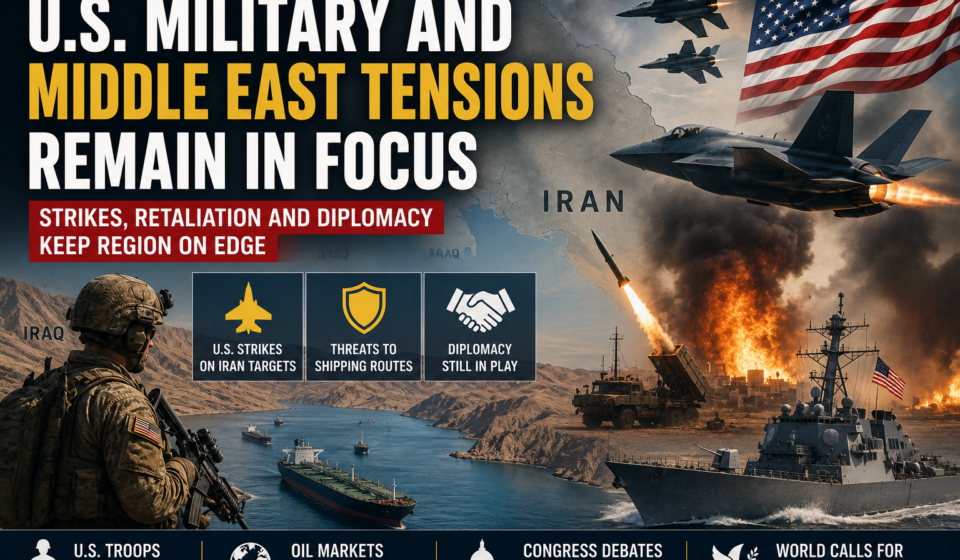
Tensions across the Middle East have moved to the center of international attention as the United States expands its military campaign against Iran and Iranian-linked forces.
American strikes have continued against Iranian military, naval and logistical targets. What began as an effort to reduce Iran’s ability to threaten shipping has widened to include missile facilities, communications networks, roads, bridges and other infrastructure connected to military operations.
The latest phase of fighting followed the collapse of a short-lived ceasefire. Since then, the United States and Iran have exchanged attacks across the region, increasing the danger of a wider war.
President Donald Trump has said the United States is prepared to continue military action for as long as necessary. At the same time, he has suggested that a negotiated agreement with Tehran remains possible.
This combination of military pressure and diplomatic language has created uncertainty about Washington’s ultimate objective.
The administration says the campaign is intended to protect American troops, defend commercial shipping and weaken Iran’s ability to attack U.S. interests and regional allies.
U.S. Central Command has confirmed multiple waves of strikes against Iranian targets. Official military material released in July showed that operations were continuing as American forces increased pressure on Iran’s military infrastructure.
Recent attacks have reportedly reached beyond Iran’s coastal defenses.
U.S. strikes have targeted Revolutionary Guard installations, missile-production facilities and military sites closer to Tehran. This broader target list suggests that the campaign is no longer limited to maritime security.
Iran has responded with drones and missiles aimed at American bases and facilities in neighboring countries.
Attacks or attempted attacks have affected sites in Bahrain, Kuwait, Jordan and Iraq. These actions have placed thousands of American military personnel and regional civilians at greater risk.
American service members have been killed and injured during the conflict.
A strike on a U.S. base in Jordan killed three American soldiers, according to reporting based on military and family notifications.
The casualties have increased political pressure on the administration to explain the mission, the expected duration of the conflict and the conditions required to end military operations.
The Pentagon has described its goals as focused, but the expanding list of targets has raised questions about whether the United States is moving toward a much larger war.
2. Shipping Routes and Energy Markets Face Growing Danger
One of the most serious concerns is the security of the Strait of Hormuz.
The narrow waterway connects the Persian Gulf to the Arabian Sea and serves as one of the world’s most important routes for oil and gas shipments.
Iran has long viewed the strait as a strategic point of leverage. During the latest conflict, Iranian military activity and attacks on vessels have disrupted shipping and increased insurance costs.
The United States initially focused many of its operations on Iranian naval forces, coastal defenses and missile systems believed to threaten commercial traffic.
However, the conflict has now spread beyond the Strait of Hormuz.
The Iran-aligned Houthi movement in Yemen has intensified attacks in and around the Red Sea. The group has targeted vessels and announced measures against Saudi-linked shipping, creating a second major danger point for global energy transportation.
Two Saudi oil tankers were reportedly attacked in the Red Sea, adding to fears that the conflict could damage energy supplies and force ships to avoid important trade routes.
The Red Sea leads to the Bab el-Mandeb Strait and the Suez Canal. Together, these routes connect Asian markets with Europe and the Atlantic.
When vessels avoid the area, they may be forced to travel around Africa, increasing transportation time, fuel use and shipping costs.
Oil markets have reacted sharply to the escalation.
Prices have risen as traders assess the possibility of prolonged interruptions in the Strait of Hormuz and the Red Sea. The effect can extend beyond fuel prices because transportation and energy costs influence food, manufacturing and consumer goods.
Oman has publicly called for the Strait of Hormuz to remain open and accessible to international shipping. Its government emphasized that major waterways should not be obstructed by military action.
Other Gulf governments face a difficult situation.
Several host American military forces and depend on U.S. security cooperation. At the same time, they are located close to Iran and are vulnerable to missile or drone attacks.
Facilities in Kuwait and other Gulf states have reportedly been struck or threatened during the fighting.
This has increased pressure on governments to strengthen air defenses while also encouraging diplomacy.
A wider regional war could damage oil terminals, ports, power plants and desalination facilities. Such infrastructure is essential to both the economy and daily life across the Gulf.
The State Department has issued a worldwide caution warning that U.S. diplomatic facilities, businesses and other American-linked locations could be targeted by Iran or groups supportive of Tehran.
Americans have been advised to reconsider travel through parts of the Middle East and to monitor changes in airport and airline operations.
3. Congress Challenges the Administration Over War Powers
The conflict has also created a major constitutional debate in Washington.
Under the U.S. Constitution, Congress has the authority to declare war and approve military funding. Presidents, however, have often used their powers as commander in chief to order military action without a formal declaration.
Lawmakers from both parties are questioning whether the Trump administration has provided enough information about the Iran campaign.
The House of Representatives voted to limit aspects of the conflict, with several Republicans joining Democrats in challenging the administration’s use of military power.
The vote reflected growing concern that the mission has expanded without a clear authorization from Congress.
Some lawmakers say the White House has not adequately explained the legal basis for continued strikes, the number of casualties or the financial cost of the war.
Democrats have pressed the Pentagon for greater transparency regarding American deaths and injuries.
Critics have also accused the administration of understating the scale of the conflict.
They argue that repeated strikes over many nights, attacks on targets deep inside Iran and the deployment of additional forces amount to a sustained war rather than a limited defensive operation.
Supporters of the president say he must retain the flexibility to protect American forces and respond quickly to Iranian attacks.
They argue that waiting for a lengthy congressional debate could weaken the military response and allow Iran to act without consequences.
The administration has relied on self-defense arguments and broader legal justifications connected to Iranian attacks on U.S. personnel, allies and commercial shipping.
The State Department has also published a legal defense of earlier operations against Iran, describing them as responses to Iranian aggression and proxy attacks.
The disagreement is likely to continue as Congress debates military spending.
The administration has sought additional funding for Middle East operations, while lawmakers are demanding clearer objectives and stronger oversight.
War-powers measures do not always succeed in stopping military action.
Even when they pass one chamber of Congress, they may fail in the other chamber or face a presidential veto.
Nevertheless, such votes are politically important because they show whether support for the campaign is weakening.
The debate may become more intense if American casualties rise, military costs increase or the conflict continues into the 2026 midterm election season.
Public opinion could also shape congressional action.
Voters may support strong retaliation after attacks on U.S. forces, but prolonged wars without a clear endpoint have historically created political problems for presidents.
4. Diplomacy Continues Despite the Fighting
Although military operations are expanding, diplomatic efforts have not completely ended.
President Trump has said Iran could still reach an agreement with the United States. Secretary of State Marco Rubio has also indicated that Washington remains open to negotiations.
The main challenge is that both sides are trying to improve their positions through force while discussing the possibility of diplomacy.
Iran wants relief from military pressure and economic sanctions, while the United States is demanding limits on Iran’s nuclear, missile and regional activities.
Trust between the two governments is extremely low.
Iranian leaders accuse Washington of seeking regime change or permanent military dominance. The United States accuses Iran of supporting armed groups, threatening shipping and attacking American allies.
Pakistan has reportedly explored ways to restart communication between Washington and Tehran.
China has also encouraged diplomatic efforts, reflecting its interest in stable energy supplies and uninterrupted trade routes.
Regional mediators such as Oman and Iraq may also play important roles.
These countries have maintained channels with both Iran and the United States and have previously helped facilitate indirect negotiations.
However, diplomacy becomes harder after every new attack.
Deaths of soldiers and civilians create public anger, while damage to military and economic infrastructure increases demands for retaliation.
The Houthi role further complicates negotiations.
Reuters reported that Iran had transferred missile-related equipment and Revolutionary Guard personnel to Yemen, according to sources familiar with the matter.
Iran denies controlling every action taken by allied groups, but Washington views Tehran as responsible for supporting and arming them.
Any meaningful settlement may therefore need to address not only direct U.S.-Iran fighting but also attacks by regional armed organizations.
Israel’s position is another important factor.
Although Israel has reportedly remained outside the latest phase of direct fighting, its security concerns about Iran’s nuclear and missile programs continue to influence U.S. policy.
Saudi Arabia and other Gulf states are also central to the diplomatic picture.
The Trump administration is discussing deeper security and nuclear cooperation with Riyadh. At the same time, Saudi facilities and tankers face threats from Iranian-linked forces.
A successful peace agreement would need to reassure these regional partners without creating terms that Iran views as surrender.
That balance will be extremely difficult to achieve.
5. What Could Happen Next
The Middle East remains at risk of further escalation.
One possibility is that the United States continues its current strategy of repeated air and missile strikes while avoiding a large ground invasion.
This approach could weaken Iranian military capabilities, but it may not force Tehran to accept American terms.
Iran has shown that it can retaliate through missiles, drones, naval activity and allied armed groups.
A prolonged exchange could therefore continue for weeks or months.
Another possibility is a major expansion of American attacks.
President Trump has reportedly considered a much larger strike against Iran.
Such an operation could target additional military, nuclear or leadership facilities.
However, a larger attack would also increase the risk of Iranian retaliation against American bases, regional allies, shipping routes and energy infrastructure.
The United States has moved additional military capabilities toward the Middle East, giving the president more options.
More aircraft, naval forces and missile-defense systems could strengthen deterrence, but their presence could also make the region more heavily militarized.
A diplomatic breakthrough remains possible.
Both sides have publicly left the door open to negotiations, and regional mediators are working to restore communication.
A temporary ceasefire could focus on protecting shipping and stopping attacks on military bases.
A broader agreement would be much harder.
It would likely require negotiations over Iran’s nuclear activities, sanctions, missiles, proxy forces and regional security guarantees.
The economic consequences will remain significant even without further escalation.
Higher oil prices can increase gasoline, transportation and manufacturing costs around the world.
Commercial shipping disruptions may also worsen inflation and weaken economic growth.
For the United States, the conflict raises questions about military readiness.
Sustained operations require expensive missiles, aircraft maintenance, intelligence support and protection for bases across a large region.
They can also reduce the equipment and resources available for other priorities in Europe and the Indo-Pacific.
For Middle Eastern civilians, the risks are more immediate.
Missile attacks, airstrikes and damage to public infrastructure can affect water supplies, electricity, transportation and medical services.
The longer the conflict continues, the greater the danger of humanitarian consequences.
For now, the United States appears committed to maintaining military pressure while continuing to speak about diplomacy.
Iran is responding with its own attacks and using allied groups to increase pressure across multiple fronts.
Congress is demanding greater control, Gulf countries are seeking protection and energy markets are preparing for further disruption.
The situation remains highly unpredictable.
A single strike causing mass casualties, major damage to an oil facility or closure of a shipping route could rapidly transform the conflict.
That is why U.S. military operations and Middle East tensions remain among the most closely watched global developments of 2026.