
1. A New Phase in America’s Global Trade Policy
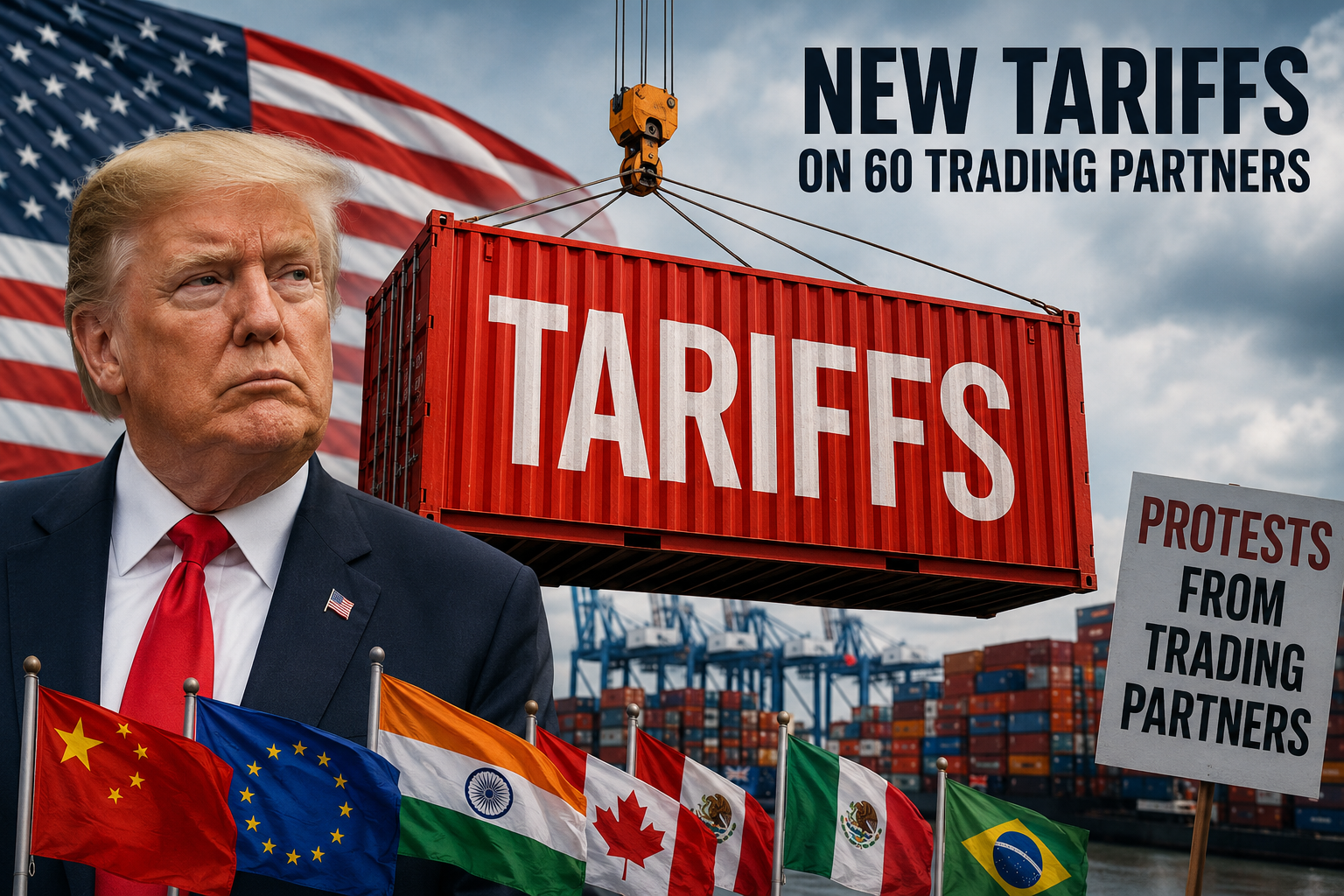
President Donald Trump has imposed a new series of tariffs on imports from 60 trading partners, marking another major expansion of the United States’ protectionist trade policy.
The new duties took effect on July 24, 2026. They generally impose additional tariffs of either 10% or 12.5% on goods entering the United States from the affected economies.
The list includes several of America’s largest trading partners, including China, the European Union, India, Australia, Brazil, Norway and Switzerland. Some countries covered by existing trade agreements received exemptions or special treatment for certain products.
The Trump administration said the tariffs were introduced because the targeted economies had failed to adequately prohibit or enforce restrictions on goods produced using forced labor.
According to the Office of the United States Trade Representative, the new measures were imposed under Section 301 of the Trade Act of 1974. The law allows the United States to respond to foreign practices that it considers unreasonable, discriminatory or harmful to American commerce.
The administration launched investigations into the 60 economies in March 2026. Public hearings were held in April, and the U.S. trade representative announced formal findings in June.
Officials concluded that the failure of these economies to properly restrict imports connected to forced labor placed an unfair burden on American businesses and workers.
The administration therefore introduced tariffs as a form of economic pressure. It argues that countries seeking access to the American market should establish stronger systems for identifying and blocking products associated with abusive labor practices.
The tariffs also replace a temporary 10% global import surcharge that expired at the same time. That temporary duty had been introduced after earlier elements of Trump’s global tariff program faced legal challenges.
By relying on Section 301, the administration is attempting to place the new trade restrictions on a stronger legal foundation.
However, critics believe the forced-labor justification is being used to maintain a broad tariff system rather than to directly address labor abuses.
Several human-rights specialists have also questioned whether general tariffs are an effective way to eliminate forced labor. They argue that targeted import bans, stronger inspections and improved supply-chain transparency may be more effective than duties applied to entire countries.
2. How the New Tariffs Will Work
The new tariff system divides affected trading partners into different categories.
Some economies will face an additional tariff of 10%, while others will be charged 12.5%. The lower rate generally applies to countries that have introduced forced-labor import restrictions, agreed to make reforms or entered trade arrangements with the United States.
The higher rate applies to countries that Washington believes have not taken sufficient action.
The tariffs do not cover every imported product. The administration has provided exemptions for several strategically important categories, including oil, natural gas, fertilizers and certain critical minerals.
These exemptions are significant because the United States depends on foreign suppliers for many essential resources.
Applying additional tariffs to energy and fertilizer imports could have raised fuel prices, increased farming costs and placed further pressure on American consumers.
Other exemptions cover hundreds of individual product categories. Some countries also benefit from previously negotiated trade arrangements that limit the total tariff applied to their exports.
The European Union, for example, said the new measures appear to remain broadly consistent with the trade framework it negotiated with the United States in 2025.
Certain European products, including selected aircraft parts, generic medicines, diamonds and cork, received exclusions. European officials cautiously welcomed those exemptions but rejected the claim that the bloc has weak labor standards.
Mexico also expects limited immediate disruption. Goods that comply with the United States-Mexico-Canada Agreement will generally remain exempt from the new duties.
Mexico’s economy minister said that approximately 85% of the country’s exports to the United States would continue entering without tariffs under the regional trade agreement.
For some countries, however, the new tariffs will be added to duties already in place. This means the total tax on certain imports may be considerably higher than 10% or 12.5%.
Industries that rely heavily on imported machinery, clothing, consumer goods, industrial components and raw materials may therefore face higher expenses.
American importers technically pay tariffs when goods enter the country. Those businesses must then decide whether to absorb the additional expense, reduce profits, negotiate lower prices from suppliers or pass the cost to customers.
As a result, tariffs imposed on foreign products can eventually increase prices inside the United States.
The final effect will depend on the type of product, the strength of consumer demand and whether American companies can find alternative suppliers.
3. Trading Partners Reject Washington’s Claims
The announcement drew criticism from a number of affected governments.
China, Australia, Brazil and Norway were among the countries that disputed the administration’s reasoning and described the tariffs as unjustified.
Many governments argued that they already have laws against forced labor and have taken steps to improve transparency in international supply chains.
They also questioned why tariffs were applied broadly to national exports rather than targeted at specific companies, industries or shipments linked to documented labor violations.
Switzerland formally rejected the allegations underlying the American investigation. Its government said it had taken note of the tariffs but did not accept Washington’s assessment of its policies.
At the same time, Swiss officials acknowledged that the new duties remained within the limits of a previous agreement with the United States.
European officials expressed similar concerns.
European Union foreign-policy chief Kaja Kallas questioned the logic of accusing the bloc of inadequate labor protections. She pointed to Europe’s employment rules, paid-leave requirements and broader worker protections as evidence that the U.S. allegations were not well grounded.
Despite rejecting the accusations, the European Commission offered a guarded response rather than announcing immediate retaliation.
The bloc said the tariff decision included useful exemptions and appeared to respect parts of the existing U.S.-EU trade arrangement.
This cautious reaction shows that many trading partners are attempting to avoid another uncontrolled trade conflict.
Governments may disagree strongly with Washington’s explanation but still prefer negotiation over retaliation.
Retaliatory tariffs can quickly damage exporters on both sides. They may also affect politically sensitive industries such as agriculture, automobiles, food, alcohol and manufacturing.
However, some countries have signaled that they are prepared to respond if American tariffs continue expanding.
Canada, which has also faced separate U.S. duties on several products, has said it may consider retaliatory action. Canadian Prime Minister Mark Carney stated that his government would defend the country’s interests in its trade dispute with the United States.
The risk is that each new measure may encourage another government to introduce its own restrictions.
A cycle of tariffs and counter-tariffs could weaken international trade, disrupt supply chains and make cross-border investment more difficult.
It could also damage cooperation on the very issue the administration says it wants to address: forced labor.
Countries may be less willing to share information or coordinate enforcement when trade negotiations become increasingly confrontational.
4. Economic Consequences for Businesses and Consumers
The immediate reaction in financial markets was relatively limited, partly because the new tariff rates were close to levels that many companies had already expected.
Businesses have spent much of Trump’s presidency preparing for changing trade rules.
Some companies have moved production, diversified suppliers or increased inventories before new tariffs take effect.
Even so, the long-term economic consequences could be substantial.
The new system reportedly affects trading partners responsible for approximately 99.4% of U.S. goods trade, although many individual products are exempt.
This means tariffs are becoming a permanent feature of America’s economic relationship with much of the world.
Supporters argue that the policy will encourage companies to manufacture more goods inside the United States.
They believe foreign producers have benefited from lower labor costs, government subsidies and weaker regulations, making it difficult for American factories to compete.
Higher import taxes, in their view, can reduce that disadvantage.
Tariffs can also generate significant government revenue. That money may be used to support domestic programs, reduce budget pressures or assist industries affected by foreign competition.
However, economists frequently warn that tariffs are not paid only by foreign countries.
American importers initially pay the charges, and at least part of the cost may be transferred to households through higher retail prices.
Products such as clothing, electronics, furniture, industrial equipment and household supplies may become more expensive when companies cannot easily replace foreign suppliers.
Small businesses could face particular difficulties.
Large corporations often have greater negotiating power, more financial reserves and larger supply networks. Small importers may have fewer alternatives and less ability to absorb sudden cost increases.
Two American small businesses have already filed a lawsuit challenging the forced-labor tariffs.
The companies argue that the administration did not provide sufficiently specific evidence linking the targeted countries to forced-labor imports. They also claim that Section 301 has traditionally been used against more narrowly defined trade practices rather than broad categories of imports.
The case could become an important test of presidential authority over trade.
If courts uphold the tariffs, future administrations may have wider power to impose large-scale trade restrictions under Section 301.
If the courts reject them, the White House may have to find another legal method to preserve its tariff policy.
Inflation is another major concern.
Tariffs do not automatically create large price increases, especially when demand is weak or businesses absorb part of the cost.
Nevertheless, repeated duties across thousands of products can gradually raise expenses throughout the economy.
Manufacturers may pay more for imported components. Transportation companies may face higher equipment costs. Retailers may pay more for finished goods.
Those costs can eventually reach consumers.
5. What Comes Next for the United States and Its Partners
The tariff announcement is unlikely to be the final step in the dispute.
Affected countries may request consultations, seek exemptions or challenge the measures through American courts and international trade institutions.
Some governments may also offer policy changes in exchange for lower duties.
The Trump administration has presented tariffs as both an enforcement tool and a negotiating strategy.
Countries that strengthen forced-labor import bans or make new trade commitments may receive more favorable treatment.
This gives Washington significant leverage because access to the American consumer market remains extremely valuable.
At the same time, frequent changes in tariff policy create uncertainty.
Businesses make investment decisions years in advance. Factories, shipping agreements and supply chains cannot always be changed quickly.
When tariff rates shift repeatedly, companies may delay expansion or avoid long-term commitments.
The new measures also raise broader questions about the future of the global trading system.
For decades, the United States encouraged lower tariffs, international trade agreements and predictable commercial rules.
The latest policy reflects a different approach, in which access to the American market is increasingly linked to U.S. labor, security and economic priorities.
Supporters describe this as a necessary correction to an unfair global system.
Opponents see it as a move toward protectionism that could weaken alliances and increase costs at home.
The forced-labor issue further complicates the debate.
Few governments openly defend products made under coercive conditions. Most agree that forced labor should be eliminated from global supply chains.
The disagreement concerns whether broad national tariffs are a fair or effective solution.
Targeted enforcement could directly block suspicious shipments and punish companies connected to abuse.
Broad tariffs, by comparison, affect legitimate exporters as well as businesses with questionable labor practices.
For now, the Trump administration is moving ahead with its strategy.
Trading partners are protesting the reasoning behind the policy, but many are responding carefully to avoid a larger economic confrontation.
The result is an uneasy new phase in global trade.
The United States is using the power of its market to demand changes abroad, while foreign governments are balancing opposition with the need to preserve commercial access.
The final impact will depend on court decisions, diplomatic negotiations and the reaction of businesses and consumers.
What is already clear is that tariffs are no longer being treated as a temporary negotiating threat.
They have become a central instrument of American economic policy, with consequences that will be felt far beyond Washington.