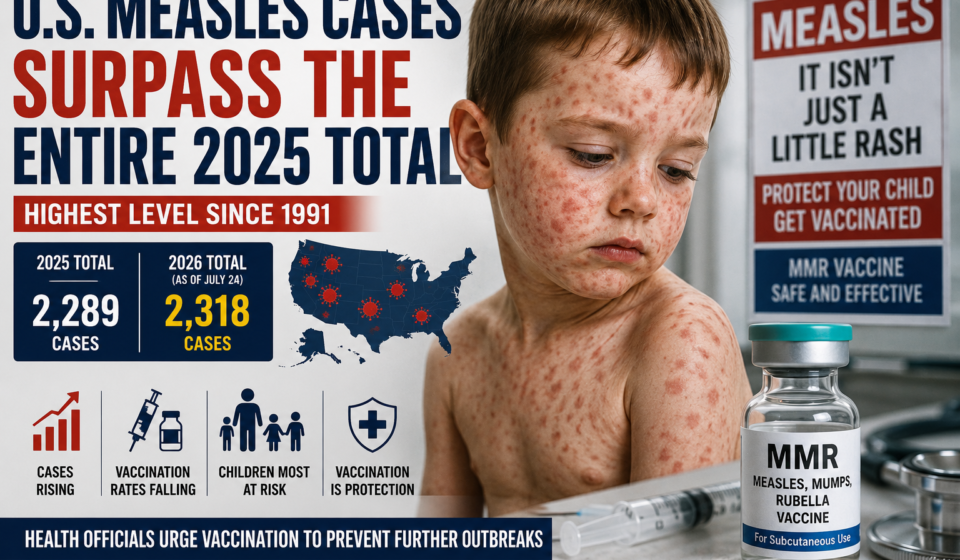

1. Measles Cases Reach a 35-Year High
The United States has recorded more measles infections in the first seven months of 2026 than it reported during all of 2025, marking another serious setback for the country’s disease-prevention efforts.
According to an update from the U.S. Centers for Disease Control and Prevention, 2,318 confirmed measles cases had been reported in the United States by July 24, 2026. The country recorded 2,289 cases during the whole of 2025.
The latest figure makes 2026 the worst year for measles in the United States since 1991, even though five months remain in the year.
Public-health specialists say the rapid increase is particularly troubling because measles was declared eliminated in the United States in 2000. Elimination does not mean that no cases occur. It means the disease is no longer continuously spreading within the country for at least 12 months.
Imported infections can still enter the United States through international travel. However, those cases usually cause only limited transmission when vaccination coverage is high.
The current situation is different because the virus has repeatedly reached communities where many children and adults are not fully vaccinated.
The CDC had documented 35 measles outbreaks in 2026 by late July. Major outbreaks in South Carolina, Utah and Arizona, together with smaller clusters in several other states, contributed to the national increase.
South Carolina experienced one of the country’s most significant outbreaks. The outbreak, which began in October 2025 and continued into April 2026, infected nearly 1,000 people, according to reports based on public-health data. It became the largest outbreak concentrated in one location since measles was eliminated nationally in 2000.
Utah has also reported hundreds of infections. Health researchers have warned that the number of confirmed cases may not represent the full scale of transmission because some infected people may never be tested or officially reported.
Other outbreaks and clusters have appeared in Virginia, Pennsylvania, Florida, Texas and additional states. The pattern shows that measles is not limited to one region of the country.
Health officials are now watching whether sustained transmission could cause the United States to lose its measles-elimination status. The Pan American Health Organization is expected to review the situation and could make a determination later in 2026.
2. Why Measles Is Spreading Again
The main factor behind the resurgence is the growing number of people who are not protected by vaccination.
Measles is one of the most contagious infectious diseases. It spreads through the air when an infected person coughs, sneezes, talks or breathes. The virus can remain in the air or on surfaces in an enclosed space for as long as two hours after the infected person has left.
Among people who are not immune, exposure frequently leads to infection. Public-health authorities estimate that an infected person can transmit measles to most unprotected people around them.
Because the virus spreads so efficiently, communities generally need vaccination coverage of about 95% to prevent sustained outbreaks.
However, the national vaccination rate among U.S. kindergartners fell to approximately 92.5% during the 2024–2025 school year. That was below the level considered necessary to reliably stop widespread measles transmission.
National averages can also hide much larger local gaps.
A state may report vaccination coverage above 90%, while individual counties, schools or neighborhoods may have much lower rates. When many unvaccinated people live or gather together, the virus can spread rapidly after a single infected traveler introduces it.
Some children remain unvaccinated because their families have difficulty obtaining medical care. Transportation problems, shortages of healthcare providers, inadequate insurance coverage and missed appointments can all reduce vaccination levels.
Other parents delay or refuse vaccination because of safety concerns or misinformation.
The false claim that the measles, mumps and rubella vaccine causes autism has been repeatedly discredited. Nevertheless, the claim continues to circulate through social media and political debate, influencing some families’ decisions.
Medical organizations have described the current resurgence as preventable. They argue that reduced confidence in vaccines has weakened the protection that once stopped imported cases from becoming large outbreaks.
The disruption caused by the COVID-19 pandemic may also have contributed to vaccination gaps. Some children missed routine medical appointments, while public-health departments diverted staff and resources toward the pandemic response.
Although many vaccination programs later attempted to reach children who had fallen behind, coverage has not fully recovered in every community.
Frequent travel is another important factor. Measles continues to circulate in many parts of the world, and an infected traveler can enter the United States before realizing that they are sick.
Symptoms usually do not appear immediately after exposure. A person may travel, attend school, visit stores or participate in community events before the characteristic rash develops.
The problem begins when an imported infection reaches a population with insufficient immunity. In a highly vaccinated community, the virus generally has difficulty finding enough susceptible people to maintain transmission. In a community with significant vaccination gaps, one case can grow into a large outbreak.
3. Symptoms, Complications and People at Greatest Risk
Measles often begins with symptoms that can resemble other respiratory illnesses.
Symptoms typically appear about seven to 14 days after exposure. Early signs may include a high fever, cough, runny nose and red or watery eyes. A rash usually develops several days later and spreads from the face and hairline to the rest of the body.
A person with measles may be contagious before the rash becomes visible.
Patients are generally considered contagious from about four days before the rash appears until four days afterward. This allows the virus to spread before families or doctors recognize the illness.
Many people recover, but measles is not a harmless childhood infection.
The disease can cause ear infections, severe diarrhea and pneumonia. In more serious cases, patients may develop encephalitis, which is swelling of the brain and can lead to permanent neurological damage.
Before the vaccine became available in 1963, an estimated three million to four million Americans were infected with measles every year. Among reported cases, the CDC estimates that 400 to 500 people died annually, approximately 48,000 were hospitalized and about 1,000 developed encephalitis.
Young children face a particularly high risk of complications.
Infants who are too young to receive the routine first MMR dose depend partly on the vaccination of people around them. When community immunity declines, these babies become more vulnerable.
Pregnant women without immunity may also face serious health risks. Measles during pregnancy can be associated with complications, including premature birth and low birth weight.
People with weakened immune systems can experience severe disease and may not be able to receive certain live vaccines. Their protection therefore depends heavily on high vaccination coverage among relatives, caregivers and the wider community.
Malnourished children, especially those with vitamin A deficiency, can also experience more serious illness. Doctors may administer vitamin A to hospitalized children with measles under medical supervision.
Public-health officials warn against using large doses of vitamin A without professional guidance. Excessive amounts can be toxic, and vitamin A is not a substitute for vaccination.
There is no specific antiviral treatment that routinely cures measles.
Medical care usually focuses on controlling fever, maintaining hydration, treating complications and monitoring patients for breathing difficulties or neurological symptoms.
Anyone who suspects measles should contact a healthcare provider before entering a clinic or hospital waiting room. Calling ahead allows medical staff to arrange isolation and reduce the possibility of exposing other patients.
4. Vaccination Remains the Strongest Protection
The CDC says two doses of the measles, mumps and rubella vaccine provide the best protection against measles.
Under the routine U.S. childhood schedule, the first MMR dose is generally given between 12 and 15 months of age. The second dose is usually administered between four and six years of age.
During an outbreak or before certain international travel, doctors may recommend an adjusted schedule for some children. Families should follow guidance from qualified healthcare professionals and local public-health authorities.
Two doses of the MMR vaccine are highly effective at preventing measles. Breakthrough infections can occur, but vaccinated patients are far less likely to become infected than people without immunity.
Vaccination also provides benefits beyond individual protection.
A person who is vaccinated is less likely to become infected and pass the virus to an infant, cancer patient, pregnant woman or another vulnerable person.
This community protection is essential because not everyone can safely receive every vaccine.
Health departments responding to outbreaks may organize free vaccination clinics, identify people who were exposed and require unvaccinated contacts to remain away from schools or public gatherings for a defined period.
Quarantine measures can be disruptive, but officials use them to prevent people who may be infected from exposing others during the incubation period.
Schools play a major role in measles prevention because children spend long periods in close contact.
Most states require proof of vaccination for school attendance, while allowing limited medical exemptions and, in some jurisdictions, religious or personal exemptions.
When exemption rates rise within particular schools, outbreaks can spread even if statewide vaccination figures appear relatively strong.
Public-health specialists say rebuilding confidence requires more than simply repeating that vaccines are safe.
Parents may need accessible appointments, clear answers from trusted clinicians and information presented in familiar languages. Communities may also require mobile clinics, extended hours and vaccination programs connected to schools.
Doctors and nurses remain among the most trusted sources of vaccine information. A direct conversation with a healthcare professional can help families distinguish verified medical evidence from misleading online claims.
The present outbreak is also a reminder that the success of vaccines can make the diseases they prevent seem less dangerous.
Many younger parents have never seen a child seriously ill with measles. As memories of the disease fade, concern about the vaccine can sometimes become stronger than concern about the infection itself.
The return of large outbreaks shows what can happen when vaccination coverage declines.
5. What the Rising Case Count Means for the United States
Surpassing the entire 2025 total before the end of July is not only a statistical milestone. It indicates that the conditions allowing measles to spread have become deeply established in parts of the country.
The final 2026 count could rise substantially because outbreaks remain active and schools will reopen in many states during the coming months.
School reopening can create new opportunities for transmission when infected children enter classrooms with low vaccination coverage.
Public-health departments will need to quickly identify cases, trace contacts, notify exposed families and offer vaccination.
These activities require trained workers and reliable funding. Local health agencies often manage several emergencies at once, including other infectious diseases, environmental hazards and routine community-health programs.
Experts have warned that weakened public-health infrastructure can make outbreak control more difficult.
The possibility of losing measles-elimination status would carry symbolic and practical importance.
The United States achieved elimination in 2000 after decades of vaccination and disease-control work. Losing that status would indicate that measles had once again maintained continuous domestic transmission.
It would not mean the country had returned to the millions of annual infections seen before vaccination. It would, however, demonstrate a serious failure to maintain one of modern public health’s major achievements.
The situation also affects other countries.
Measles does not respect national borders. Continued transmission in the United States can lead infected travelers to carry the virus elsewhere, just as imported cases can enter America.
Coordinated international surveillance and vaccination are therefore necessary to control the disease.
For individuals, the immediate advice remains straightforward.
People should review their vaccination records, speak with a healthcare professional if they are uncertain about immunity and follow local health-department notices during an outbreak.
Anyone exposed to measles should promptly contact a doctor or public-health agency for guidance.
People experiencing fever, cough, red eyes and a spreading rash should avoid public spaces and call ahead before seeking in-person treatment.
The national rise in measles cases is a warning that diseases once considered controlled can return when protection weakens.
The United States still has the tools to stop measles transmission. The MMR vaccine is widely available, disease-surveillance systems can detect outbreaks and health departments know how to interrupt transmission.
The challenge is ensuring that those tools reach every community and that enough families choose to use them.
Unless vaccination gaps are closed, imported cases will continue to find groups of susceptible people, creating new outbreaks and placing vulnerable Americans at unnecessary risk.
The fact that 2026 has already exceeded the full 2025 case total shows the urgency of the problem.
Measles was eliminated through sustained vaccination, public trust and coordinated health action. Preventing its return will require the same commitment again.